Sunday, July 10, 2011

The day I met a Knight of St John

Many years ago my good wife was au pair to the families of a pair of sisters, whose mother was one of those ladies often described as 'indomitable'. The kind on whom the British Empire was built. I had the privilege of meeting her once but could happily have done with more. She died at the age of 92 and on Friday we were at a thanksgiving mass for her life.

Born in Kenya, she apparently had this recent exchange with a Kenyan immigration official:

"How long are you staying in Kenya?"

"I don’t know."

"Have you visited Kenya before?"

"Yes."

"How long did you stay then?"

"Sixty years."

Anecdotes about her life included finding a gun lying around in the house of one of the suspects in the White Mischief murder. "Don't ask," she was advised, so she didn't, and quietly put it back.

A lovely service with some good tunes: 'How great thou art', 'I, the Lord of sea and sky' (a surprisingly modern choice) and, um, The Battle Hymn of the Republic. I'd quite like that last one at my own funeral, but for me the only version worth having is performed by the Mormon Tabernacle Choir and the vicar might have something to say about that.

Anyway. I was moved by the service and also by something else even closer to my heart. There’s a biblical passage where we're enjoined not to take the seat of honour at a gathering, because someone more important may turn up and we’ll be hideously embarrassed to have to go and sit somewhere else. Instead, says Jesus, sit at the back so that you can be guided up to a more important position by the host.

Which is exactly what happened to us. All prepared to sit quietly at the back, one of the grandsons that Beloved had looked after as a small boy firmly guided us further up the church, assuring us (well, her) that we're family. That was just the start of an afternoon that made me feel truly privileged, because men and women she hadn't seen for decades were falling on her and hugging her and thanking her for coming, and I realised how much she had touched their lives way back when, and now I have the blessing of being married to her.

And the Knight of St John? He was actually the priest conducting the service. I noticed this strange cross a bit like the Blue Max bobbing at his throat as the service went on, but as he probably wasn't a German WWI fighter ace I had no idea what it could be. Afterwards we shook hands, and I asked, and he told me. Cor, knock me down with a feather.

The Reverend Father knows, let's say, how to work a room. Voice trembling with emotion – he was an old friend of the departed – he told during his homily how, on the day she died, he had been driving in the country, and stopped for a sandwich, and a little robin alighted upon his arm, whereupon he fed the small creature a few crumbs and it flew off again. "I don't know what you think of that," he finished.

Later the oldest grandson privately told us exactly what he thought: "I think you’re a f&^%ing liar, Father!" But he said it with a big smile, and grandmother would have had a good laugh.

Tuesday, July 05, 2011

The fundamental things apply to rock carvings and Earthsea

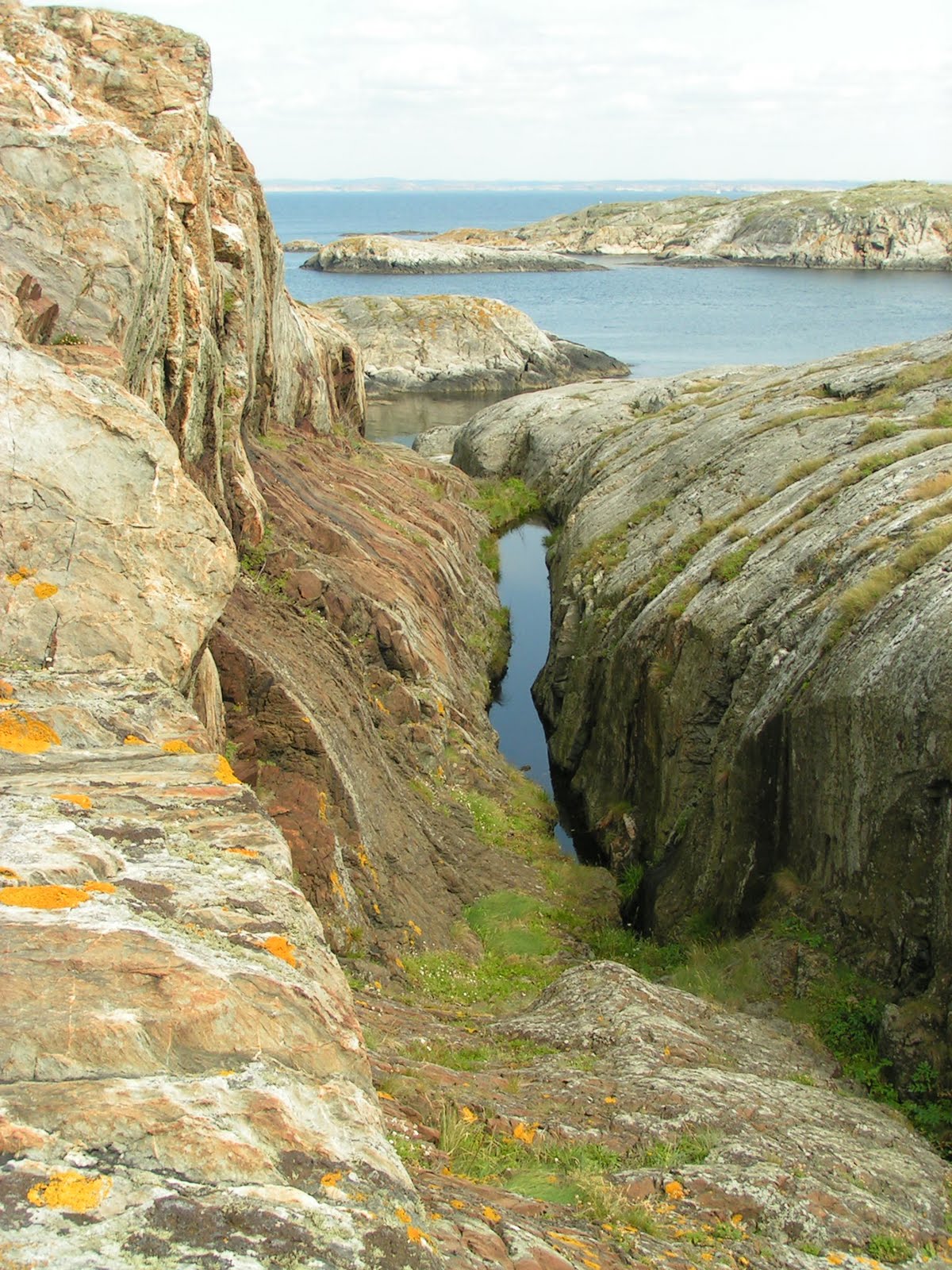
The west coast of Sweden is flat, fertile farmland, except where it isn’t. Where it isn’t is because of rocks – large, red-grey protrusions, dropped and worn smooth by ice thousands of years ago and jutting out of the soil. At the bottom end of the scale are the ones the size of a small car or maybe a house – they can be landscaped around. At the top end are the ones tens of metres high and the size of a city block. These are more accurately known as geography and there’s no landscaping here – they are the landscape and you just go around them.

At one point, the flat farmland disappears below sea level but the rocks remain. At this point you now have an archipelago.

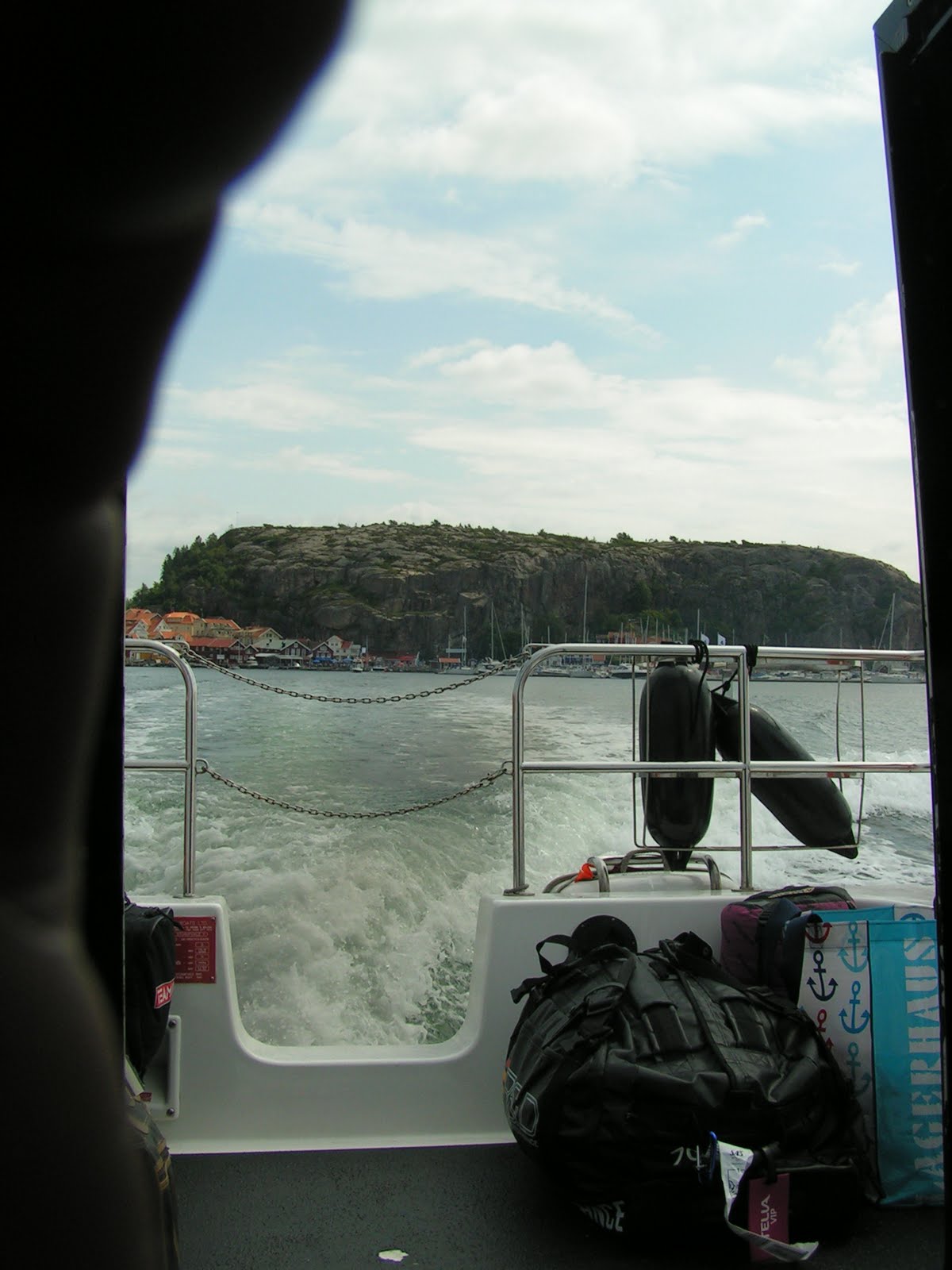
Fjällbacka is a town on the west coast, overlooked by the 75m high Vetteberget. I decided that if I weren’t already married, this is where I would have proposed. We were there at about 5pm in the afternoon, which is nowhere near sunset at that latitude but still the sun is low enough to sparkle on the water and the black dots of the islands stretch as far away towards the horizon as you can see. If you’ve never read Ursula le Guin’s Earthsea novels, now would be a very good time to start.


It was also a favourite haunt of Ingrid Bergman and they remember her fondly.


We also took a boat out to Väderöarna, largest of the islands and Sweden’s most westerly inhabited possession. Now I was not only thinking of Earthsea but also of I, Claudius, as the fate of several characters at one point or another is to be exiled to a small barren rock in the Mediterranean – the worse your downfall, the smaller and more barren the rock. If Sweden went in for that kind of thing, this place would be littered with exiles. So inevitably I got to thinking up plots and, do you know, I might actually write a story – now there’s a thing.


But there’s things to see inland too. What actually brought us to the area in the first place were the rock carvings of Tamunshede – a late Bronze Age, World Heritage phenomenon. 3000 years ago someone worked out another use for those rocky surfaces – you can carve on them. (Rather, chip away at them to a depth of between 0.5-1cm.) There are four main locations all within a couple of miles, all on south- or east-facing stones, and all on stones where the water continues to run down for a while even when it’s stopped raining. They have been coloured in by present day experts so they can actually be seen – they are so faint as to be invisible in their natural form.


Of course, we only have modern day interpretations to go on, but …

A lot of the time, men are attacking each other with axes.

At one point they are distinctly on a boat as they do so. Were they having sea battles back then?


From the design, the boats are clearly ancestors of the Viking longships, though experts say boats that size couldn’t have been built back then. Therefore, these boats have a symbolic, religious meaning – maybe a way of voyaging to the afterlife. Well, maybe – but even so, were the longships eventually built that size because someone realised that in principle there was no reason they couldn’t be?


And if the boats are symbolic, why are guys still fighting on them?

All the bows found from that time are longbows but these are quite distinctly short, like those used by Asian horsemen. Was there contact? No reason why not. All you have to do is keep going east (or from the horsemen’s point of view, west).


You can’t help but notice just how male the men are – for some reason the women are identified by long hair rather than anything, um, organic. To the right sort of mind it gives rise to all kinds of humour – no, change that, I mean one particular kind of humour. I may have thought up a few jokes but I won’t share them and I didn’t buy the book.


And (we learned) the reason horsemeat isn’t generally eaten in Sweden is because eating horsemeat was seen as a pagan practice and therefore discouraged by the early church. So religion has its uses.

Wednesday, June 08, 2011

Witney Book Festival: 9 days and counting ...

May I particularly draw your attention to the excellent events of Sunday 19th, though I should add I have never claimed to be the author of 18 novels.


Friday, May 20, 2011

Where's Michael Winner when you need him?

Friday morning: bin collection day. The binnies can come quite early so we always put the bins out the previous night. This week, grey bin and food bin.

Except that when I left the house this morning there was no sign of the food bin. I stopped the car at the entrance to the drive to ponder its absence. Had it been abducted into the food bin slave trade? Was it an early victim of tomorrow's Rapture?

No, it was lying in two pieces on the other side of the road, and our split-open food bag was lying in the gutter. I'm sure it led to much entertainment for the rush hour traffic as I dodged cars to get across and bring back the fragments. I'm guessing someone moved it from the driveway into the centre of the road, for the lulz. The driver who hit it probably isn't accountable. Probably.

Sorting it all out meant popping back upstairs for kitchen roll and a fresh food bag, trying not to touch anything because my hands were filthy, then loading up the fresh bag with the remains of the food. Coffee grounds ... egg shells ... rotting vegetables ... lovely. At the back of my mind I was aware of a car beeping its horn but I wasn't too worried because I could see no one was trying to leave the property, so I didn't think I was blocking anyone.

Turned out I was blocking someone trying to gain access, though, to visit our neighbouring flat. Immediately I noticed the car I went over to it, filthy hands held up in explanation, but she got in first with the dialogue:

"Look, are you going to move your car?" (says the total stranger with no access rights to the person who actually lives there.)

"I will. I'm having an emergency." (Hands still up, plus she had just clearly seen me put the remains of the food bin into the grey bin.)

"What emergency?" (Explanation of emergency in rising tones of irritation.) "So is that my fault? Are you going to move your car?"

Oh, how I wish I could have that five minutes back again to be decently, properly rude instead of just blowing my top at the uncivil ungracious self-obsessed baggage, which is the easy option and loses moral authority. Suggestions from helpful colleagues when I finally got into the office were:
  • The Michael Winner option: "Calm down, dear ..."
  • (holding hands up) "Do you want me to touch you?"
  • (leaning on bonnet with dirty hand) "Now look, sweetie …"
  • "Give us a kiss and tell me your problems ..."

Sunday, May 15, 2011

In a real hurry to do some shopping

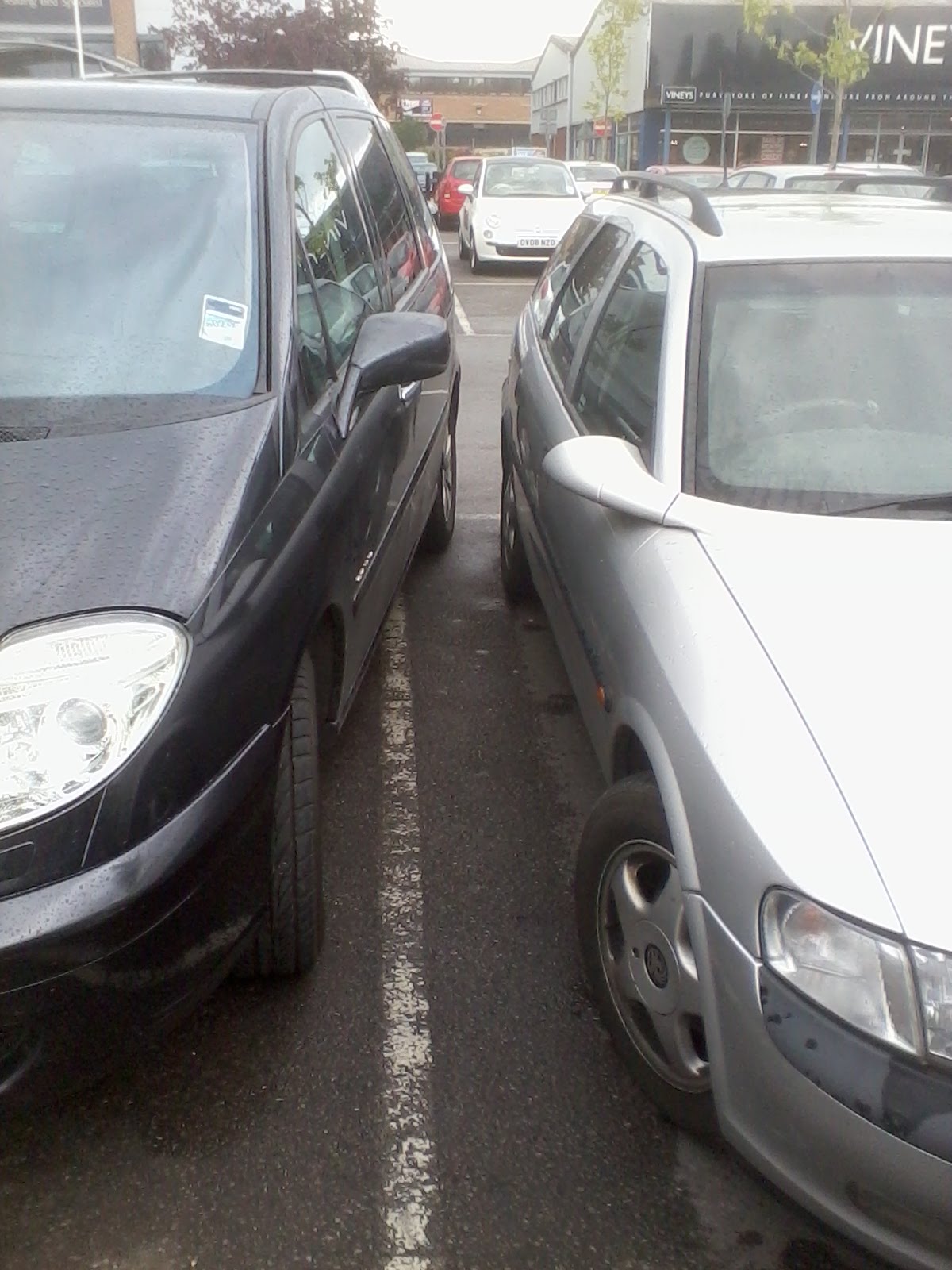
The car on the left, number plate obscured, is ours. We were there first. We came back from the shops to find the car on the right, black Citroen no. LC04AWA, had urgently parked next to us. So urgently it was choosing to ignore the niceties of white lines and other conventions like that.


Seen from the front, the artistry of their not quite hitting us becomes apparent. To get into my own car, I had to climb across from the passenger side.

Let me stress that under no circumstances should the words "learn to drive yer husband's car, luv" be used in this kind of situation, unless of course you can guarantee you're offending the right person. Just bear in mind it might have been the husband driving and have the courtesy to refine your offensive jeers accordingly.

Monday, May 09, 2011

Compliant department

Once upon a time - early to mid nineteenth century, from the available evidence - someone built a large four-storey out-of-townhouse on the far outskirts of Abingdon. It was an earlier, more innocent age. Smoke detectors and fire alarms hadn't been invented and the only noticeable fire prevention systems were the tiled floors around the fireplaces that unexpectedly come to light when inhabitants redecorate and lift up the carpets for the first time. (I said innocent, not stupid.)


In the mid 1970s, the house was converted into flats, one per floor. This was also an earlier and more innocent age, and possibly a more stupid one too, because they still didn't pay much attention to what would happen in the event of fire. The front doors off the flats were still the original doors off the hallway and landing and the only means of escape other than gravity was the central stairwell, so if that caught fire, that was your problem.

In 1991 a callow young 26-year-old moved into one of the flats, and as an owner became by default a member of the management company, but he hadn't thought much about the deeper issues of life such as dying horribly in a fire and never even raised an eyebrow at the thought that he might be living in a deathtrap. And nor did the other owners.

'Twas only in early 2010 that the young man, now a bit older and happily married and also the secretary of the management company, as the only owner-occupier left standing, was persuaded by his wife that installing battery powered smoke detectors from Homebase might add slightly to the overall happiness of the human race. They were duly installed. Meanwhile a new tenant had moved in to the top flat with her two daughters, and her ex-husband was a fireman. The fireman took one look at the building where his progeny were now dwelling and was ... unimpressed.

The first the company secretary knew was when he received a call from the fire department to say that in response to "a complaint from a member of the public" (whose identity wasn't too hard to guess: options, fireman ex-husband of neighbour, or casual passerby who surveyed the building from outside and thought "hmm, probably not safe"), he had been to visit the property and noticed the absence of smoke detectors. This was in June last year. As the detectors had been up since March, he either wasn't very observant or had visited at least three months earlier and only just got round to issuing his report. This was finally followed up in September by a formal visit, suggesting the fire department themselves weren't feeling the urgency. He agreed the battery smoke detectors were a good stop-gap but not enough. In November we (you'd guessed, hadn't you?) received formal notification that:
  1. A grade D, LD3 automatic fire alarm system is to be fitted in the common parts of the house. This comprises of mains powered, with battery back up supply smoke detectors on each landing and a break glass call point by the front door, these need to be interconnected by either wire or wireless means.
  2. All flats, including those to the rear of the premises are to have domestic smoke detectors fitted, these can be battery powered.
  3. An emergency lighting system conforming to BS 5266 is to be installed in the common parts of the house
  4. Water extinguishers should be available at each level of the landing
  5. The flat doors opening onto the common stairwell are to be 30 minute fire resisting, i.e. solid construction, self closing, have a 25mm stops and smoke and heat seals
  6. A suitable Fire Risk Assessment should be carried out listing,
    a) the fire hazards
    b) the people who are at risk
    c) evaluation/removal of these hazards
    d) a record of findings.
    e) a planed review date.
To be on the safe side we both planed and planned the review date and in between other items like having jobs, having a life and so on, it all got done by the agreed cut-off point of 30 April 2011. And today we had our formal inspection, which must have taken at least 2 minutes, and I can proudly report that we are compliant!

Or as Bonusbarn puts it, if we all die in a fire now, we can claim on insurance. Well, quite.

Thursday, May 05, 2011

Hole in the wall

This is exactly what you want to be the first thing you see when you pop home at lunchtime on a completely unrelated errand.

A hole in the wall by the side of the carpark.


At first I thought it had just crumbled and a couple of stones had fallen out. Then I saw the distinct dent in the concrete post in front of it and had one of those Pascal-like pensées: "some bugger's rammed this."

And then I went round to the other side of the wall, which is next to someone's driveway ...

Oh, dear.


There were no eye witnesses but there were ear witnesses. It happened shortly after 11am, so was probably someone making a delivery rather than a resident. That meant it wasn't hard to pin down who it might have been and after I'd contacted his company he called me to fess up: a charming Sikh gentleman who had actually been doing a quote for work on our downstairs neighbour's flat. His foot slipped on the brake, he was going to tell us but then he got a phone call and it completely slipped his mind ...

Anyway, all's well that ends well and our insurers are on top of it. We have however indicated to the owners of the flat that we would rather this gent wasn't in any way involved in work that might affect the structure of the building. Not if he's that absent minded.

It would be quite cool if the collapsed wall had revealed some hidden treasure or a map or a dead body or ... Nah, no such luck.

Tuesday, May 03, 2011

Kindle egg

They're suspicious people down at Amazon. Cheryl put up Kindle versions of His Majesty's Starship and Jeapes Japes and they promptly got taken down again until Amazon could be absolutely sure she had the right to publish them. They'd noticed paper versions exist, you see. Can't be too careful.

But, we were able to convince them and the Wizard's Tower Kindle editions of said books are now available - as already were The New World Order, The Xenocide Mission and Time's Chariot. So, the entire Jeapes oeuvre is now available Kindlectronically. Buy them now. It is your destiny.

Monday, May 02, 2011

Silence!

So, Dr Who is off with a swing. It took its time, though. It's good to be thrown into the middle of the action ... but it helps to know why we're meant to care first. Last week's episode wasn't really the start to a series; it should have been about three quarters of the way through, having previously introduced Amy + Rory + River to any new viewers. It's nice to have my intelligence respected by a TV producer who expects me to work it out, but if I was a new viewer starting from scratch, I expect I'd have got about halfway through "The impossible astronaut" before turning off out of irritation. Hey look, they're all upset that their friend's dead. But he's not! Oh, he's a younger version. So why not tell him what happened anyway? Since when did this guy, of all guys, pay close attention to the sacrosanctity of the timelines?

But that was a blip. Last week was worth persevering with and this week we strike gold, with creepy tensions and some laugh-out-loud moments, the first of which was River's means of not dying by falling from the fiftieth floor of a building. And the mystery of finding out who the little girl is will keep me more hooked than the weird crack in the wall from last year.

The Moff does have a few leitmotifs up his sleeve that he likes to reuse, doesn't he? Decaying, creepy locations, possibly with cryptic messages scrawled on the wall. Inscrutable aliens who are nasty because they're scary and inscrutable but not very good at explaining their motives. Small children in danger. The inability of two people to have a simple conversation going: "look, please can you explain what's going on?" / "Why, certainly. As you can see, I'm in this spacesuit ..." He's good at juggling them but he doesn't have that many opportunities to use them left before they start being boring ...

So, as the late Nicholas Courtney's most famous character would have said, onwards!

Sunday, May 01, 2011

On abbreviations alone we have a clear winner

I've not yet seen last night's Dr Who so I'll talk about the other burning issue on everyone's mind.

I haven't decided how I'll vote in the referendum on how to vote. Both sides make some good cases. Both also make bad ones. Nothing winds me up more than people I agree with using bad logic to support their argument; because if you can't find good logic to support it, what exactly does that say about your case?

Sad fact about FPTP: it does not guarantee the winner is the guy with the majority vote, whatever nice Mr Cameron might say. Not if they got 40% and their two opponents got 30% each. Do the sums. You can probably do that even if you are a Tory. You will get a guaranteed majority winner only if there are two candidates - and, nationally, if all constituencies are approximately equal. Which they are not.

Sad fact about AV: the most popular candidate is not the guaranteed winner - it may well be everyone's second or third choice who gets in. But (and it's a big but) the policies that candidate represents are most likely the policies of interest to the majority of voters. There's a subtle difference but it's an important one. Suddenly no seat is a safe seat; no candidate can just cruise in because they're representing a constituency that has voted the same way since 1066 and the opposition needn't bother turning up.

A strong argument against FPTP is that twice in my lifetime now it has delivered prime ministers with such a landslide majority, and the personal conviction to back it up, that they can and did do pretty well what they wanted, unopposed; and yet they did not represent anything like the majority of the country. If I knew AV would never deliver another Thatcher or Blair, that would count very heavily in its favour

A strong argument for FPTP is that contrary to popular belief, it can even cope when you get a logjam in the political process and no one wins. Like, a year ago. Given that it still works in that regard, why change it? What is beyond dispute to me that FPTP has always, always delivered the government that was needed on election day. I will say that for Thatcher and I will say it for Blair, because in both cases the opposition was so untenable. And I say election day. It may well be that within a few years, months or even weeks it is no longer the government we need; but on election day, it always has been.

Meanwhile, there are more burning issues to tackle which will go a long way to making our parliamentary system fairer. Boundary reform so that every MP represents approximately the same proportion of the population. Sorting out once and for all the present cludge that gives some citizens of the UK two parliaments and some only one. Things like that. I have a sneaking suspicion AV is just paint on the cracks. FPTP is unfair. So's life.

So, how will I vote on Thursday? Haven't decided. AV has the better publicity but it will take more than clever cat videos to win me over completely and they have four days in which to do it.

Friday, April 22, 2011

His Majesty’s Starship, part 3: a bloody children's publisher?

Slowly but surely His Majesty’s Starship approached completion ... and approached it ... and approached it. For a very long time indeed I was almost there, with just a couple of thousand words to go, and I simply wasn’t writing them. I self-diagnosed the problem, which was that I had a life and I was unwilling to lose it. The solution was to start getting up earlier, writing before going to work. It’s a habit I’ve kept.

Placing it with a publisher was quite atypically easy. Two friends from my writers group already shared an agent, Robert Kirby. Robert had been sufficiently tickled by their descriptions of the group to ask if he could have first refusal if any of the rest of us ever wrote a novel. I sent His Majesty’s Starship to him in August 1995, shortly before the Glasgow World SF Convention, which was my first worldcon. He finally accepted it, and me as a client, in January 1996. I had an agent! For a while I enjoyed dropping the words ‘my agent’ into conversation with friends, family and strangers.

(I recently came across an old letter from Robert thanking me for introducing him to his latest client, one Alastair Reynolds. Purveyor of retirement plans to agents, that's me. No finder's fee, sadly.)

And then Scholastic expressed an interest in it.

Scholastic?

A bloody children’s publisher?

Robert’s precise reason for sending the book to Scholastic was, and I quote, “Gilmore seemed to me a sort of modern day Biggles and the level of sex and violence would not have raised the collective eyebrow of readers of Captain W.E. Johns.” As Gilmore, in the draft he read, was a divorcee from a group marriage with a teenage son, and there is an alien sex scene in chapter 16, I disputed this point of view, but it’s amazing the effect having a publisher actually express interest will have on you.

Further, I had been put off Scholastic by hearing horror stories from a friend who had had a novel published by their Point SF imprint which was systematically neutered to make it suitable for a young audience. (Or rather, one suspects, for the young audience’s parents.) The approaching middle age, divorced heroine became a teenager. At one point, in the original draft, she comes down first thing in the morning and finds the boyfriend having breakfast, with the implication he had stayed overnight; now he had to walk up the garden path first thing in the morning and ring the bell to be let in.

I don’t know who edited that book but it certainly wasn’t Scholastic’s David Fickling, a boundlessly cheery Roy Hudd lookalike and publishing genius. (All my writing breakthroughs seem to be thanks to someone called David: Fickling, Pringle, Barrett ...) Practically my first card on the table when I met David was that the alien sex scene stayed. “Absolutely,” he said cheerfully. I was to learn he said a lot of things cheerfully, including his careful enumerations of your novel’s precise faults.

David was the man who had signed Philip Pullman (Northern Lights had just won the Carnegie Medal for children’s fiction) and was looking for something meatier than Scholastic’s usual teen fare for a new imprint. Robert forewarned me that David thought the book was bogged down with too much detail. I went into the meeting determined to refute this viewpoint and I left agreeing with him. I also saw how it took far too long for the story to get going, and it finished too soon – about three quarters of the way through the book, with a lot of mopping up after. I needed to rewrite it so that it ended at, you know, the end.

The kicker was: if David suspected for a moment that I was just agreeing with him to get the book published, rather than rewriting with my heart in it, he wouldn’t be interested. Not that I would have just agreed with him to get it published ... but it concentrated the mind.

This began the first of quite a few rewrites: new opening chapter, throwing us straight into the action and highlighting Gilmore’s tactical ability. A space battle, a few people killed. All good stuff. I sent off the rewrite.

Early 1997: he didn’t like it. I began to see the problem: I had added more plot but left the excess verbiage in as well. David did me a huge favour for life at this point by recommending that I read Patrick O’Brian’s Master & Commander, first of the Aubrey series. O’Brian’s characters just slide into the action: Aubrey has been through some considerable scrapes prior to the novel’s opening and we only hear about these second-hand.

I applied this to the novel and I cut out anything that didn’t directly relate to the action, including (though it broke my heart) chapter 8, in which the Rustie Arm Wild interviews the crew. That chapter was the key one to introducing not only the crew but also the alien mindset to the reader. The novel was now down to 92,000 words, from its first draft of 113,000.
Back to Scholastic, and David courted death with a casual comment along the lines of: “don’t I remember a chapter where Arm Wild interviews the crew? I quite miss that ...”

I restrained my homicidal impulse and learnt the lesson: anything that develops the characters is probably acceptable, even if it doesn’t contribute to the action. The interview was reinstated.
In January 1998 I sent in the final draft at 100,000 words, and it was accepted. And despite all the twists and turns over the last two years, it really was the story I originally wanted to tell.

I was struck by all the pluses of dealing with David, as opposed to the horror stories I had heard of other publishers: incompetent editors who want to be writers themselves and fiddle at every stage; who have no idea of science fiction beyond Star Trek; who bow to the High Priests of Marketing and tell you to put the sex here, the extra 200 pages there, and where’s that dragon when we need it? And all for a product that ultimately will have a life expectancy that makes a mayfly seem pensionable, because that’s how the bookselling system works. (Note: further on and many years later, I still have yet to meet any editors who match this stereotype ... but I was young then and, like it or not, the stereotype exists.)

I was bowled over by an editor who encouraged me to cut. Not willy-nilly, but surgically. Cut this, yes, but expand that, because you leave off just when the reader’s getting interested ... you see? And yes, I did see. David never lifted a finger to fiddle with the science fiction – that was entirely my own. He just concentrated on the story, and I came out the other end of the process a convert to the demands of children’s publishing: proper children’s publishing, not plot lobotomy as is sometimes practised. Just tell the story, then stop. That’s it. No more. Let it be as long as it needs to be. And you end with a story to be proud of: the story you wanted to tell.

I still had to stay on my toes. There were those within the Scholastic empire who clung to the old ways and David couldn’t control everything. Like, a frowning copy editor changed one character’s “Sod it!” to “Damn it!” We compromised on “Nuts!” (I had a vision of the guy wandering the corridors of their offices in New Commonwealth House muttering “Sod it / damn it / nuts / sod it / damn it / nuts ...”, perhaps looking to see which of his colleagues swooned at what.) Strangely, the occasional utterance of “Christ!” caused no upset at all; a sad reflection etc. etc.

The learning experience continued right up until the end. At proof stage, I was told it was one signature too long for its price range. Books are typically printed in multiples of sixteen pages – eight pages get printed on either side of a large sheet of paper which is then folded and trimmed. That is a signature. My choice was: cut it by sixteen pages, or let Scholastic put it up by a pound. I cut the sixteen pages. It’s humiliating to realise your book has sixteen dispensable pages in it, but it was an invaluable exercise.

His Majesty’s Starship was published in December 1998. My author copies were delivered while I was at work on the last working day before Christmas, so I had to go and collect them from the depot. As I drove away from the depot, with the holidays ahead and my first novel in the boot of my car, the radio announced that Peter Mandelson had resigned from the cabinet. And then it played the third part of Vaughan Williams’s English Folk Song Suite, a piece of music I really enjoy with a triumphant trumpet fanfare.

I was pretty pleased with myself and with life generally.

Still am.

Life goes on …

It enjoyed modest success and some fairly nice reviews: I still relish the tingle when I saw SFX had awarded it more stars than the other book on the same page, a Star Trek: Voyager novel. It went out of print in 2002. A few years later I did a print-on-demand version because I was still getting a trickle of enquiries. And then, last year, I heard Cheryl was starting a new e-book publishing company ...

Thursday, April 21, 2011

His Majesty’s Starship, part 2: B5, bad guys and by golly, a sequel

Like me, Babylon 5 was also on a mission to do right what Star Trek got wrong. Its key innovation was the story arc – the idea of an overall plot across the entire series that would take many episodes to unfold. Nowadays it’s almost unknown for a series not to have an arc. Babylon 5 gave us a universe of consequences – if a character broke a leg in one episode, they were on crutches in the next. In one episode a fighter pilot was killed and the closing shot was of Commander Sinclair composing a letter of condolence to the next of kin. Humans in Babylon 5 were a minority species, one among many, as opposed to the apartheid-like setup of Trek in which humans are clearly the minority yet equally clearly in charge of almost everything. It was a universe where it was okay to be religious, without the right-minded good guys on the one hand ‘respecting’ your faith until their hearts bled and on the other quite obviously despising it as primitive superstition.

None of it was actually original in comparison to written science fiction, which had grasped all these innovations in the fifties or earlier. For television science fiction it was brand new and I felt a lot of moral support.

Babylon 5 also gave us a feisty Jewish-Russian female second-in-command; not a combination of features you would expect to be duplicated easily. Well, I got there first! Hah!

I enjoyed dividing the Earth into the political map of 2148, including such nations as the Confederation of South-East Asia, the Pacific Consortium, the Holy Arab Union, the South American Combine and the United Slavic Federation – and of course the Vatican. Then, once I had the entire planet neatly divided into political entities, I suddenly realised to my horror that I was doing what Trekkies do – I was neatly delimiting and parcelling up a potentially fascinating future to make it manageable. So the published version names a few nations, but many more are now implied.

Books need antagonists and it would have been too easy to make the Rusties the bad guys. In fact their invitation to the nations of Earth was pretty straight, for the amount of information they chose to reveal. So, the tension had to come from within the humans. For the baddies I chose the Confederation of South East Asia. This was a superstate India and its puppet satellite states; Pakistan, Bangladesh (I take credit for the first ever Bangladeshi on a starship, I think), Afghanistan, Tibet, Sri Lanka, Burma. I really should add I had and have nothing against India – but the baddy had to be a global superpower of 2148, and I have no doubt that India will be one. Europe and North America will have long had their day by then. Whether India is a good or a bad superpower, only time will tell. In His Majesty’s Starship it’s just emerging from a mad and bad period, and there’s a tension between different factions who have different views of the past. Several of the Confederation characters are perfectly decent guys who just happen to have been born into this situation and so I gave the Confederation the NVN, an equivalent of the Waffen SS, who unquestionably are bad and not necessarily well liked by their compatriots. As I don’t speak a word of Hindi, NVN stands for ‘Not Very Nice’. NVN uniforms were plain green, based on the pyjamas I was wearing at the time. Depending which part of the novel you read, the uniforms are either dark or pale green, which has two possible explanations: dark green for dress uniform, pale for combat (or vice versa); or, they left the dark uniforms in the wash too long.

Then I unexpectedly started thinking of a sequel …

I honestly hadn’t intended to. But I showed some chapters at Milford 1994 in Rothbury, Northumberland and they came up with two unforeseen reactions. First, I explained the background plot and an immediate reaction was: that’s what the aliens want, and we’re the best they can do?! And second, a criticism was made that Gilmore was a bit bland. He needed more background. He needed a family! Thus his eighteen-year-old son Joel was generated spontaneously from the ether, together with a perfect rationale for the Rusties’ actions, and these two things together gave me enough material to write The Xenocide Mission: the only sequel I have written so far.

In part 3: finding a publisher and discovering I'm a children's author.

Wednesday, April 20, 2011

His Majesty’s Starship, part 1: origins

The lovely Cheryl tells me His Majesty’s Starship and Jeapes Japes are available in the Wizard’s Tower book store. They’re out there! EPUB and Kindle! £4.99 each! Buy them!

All of which inspires me to reminisce. In the best spirit of present-day science fiction I shall do it in three parts.

When I was young I read Robert Heinlein’s The Number of the Beast. This proved upon retrospect, and indeed upon actually doing it, to be a bad idea because it’s terrible and I couldn’t believe it had been perpetrated by the same author as my beloved Starman Jones, which I read and re-read compulsively up to the age of about 13. However, there is a very brief mention in it of a Royal Space Force. That was an image that hung around in my mind for a long time after, but I didn’t just want to fling it straight into a story as a given. I wanted to know how such a thing had come about.

Also, much as I love good ol’fashioned space opera, with space battles and hyperspace jumps and lasers, I grew up on much more plausible Arthur C. Clarke-type spaceship stories, where there is no artificial gravity and ships must obey the laws of physics. I wanted to write a story that could start in a Clarke-type universe and plausibly end with whizz-bang-splody ships.

In my twenties, I read Hornblower. I had dipped into this before but now at a stroke I now read the entire series. I was struck by an aspect of Hornblower that eluded me as a child: his self-loathing. He is a hero and can never believe it. Every mission he undertakes he is convinced will be his last – and this at a time when the English had shot Admiral Byng on his own quarterdeck for messing up. That was my hero!

I almost had a novel. I didn’t know back then that the phrase ‘Hornblower in space’ was already fast becoming a cliché; I only had a vague idea who Honor Harrington was and David Feintuch’s Hope series had yet to be published. It probably wouldn’t have been a problem if I had, though, because both those others are set well after the start of their respective eras. I however wanted to cover the beginning. For example, why exactly would anyone want to arm a spaceship?

I also wanted to bring the limitations of nineteenth century naval warfare to space, as I think the principles will be pretty similar if it ever happens. In Hornblower’s day, ships were big and slow and couldn’t hide. If you were doing five knots and your enemy came over the horizon doing five and a half, then sooner or later there would be a battle, but you could spend all day just looking at your enemy as he crept closer and closer without being able to do a thing about it. There was nowhere to run to, and when the fighting started you just sat there and took it. And so, these principles were applied to the big space battle in the novel, when it came.

Mix ’em all together and I had my background.

In Asimov’s Foundation trilogy there is a throwaway line about Gilmer, the man who sacked the Imperial capital Trantor and brought down the remains of the Empire. This led to a vague resolution as a teenager, filed away at the back of my mind next to the Royal Space Force, that I would one day chronicle the future history of the Gilmer family. To kick them off, my depressive spaceship captain was named Gilmore. Michael Gilmore, because I’ve always liked Michael as a name: I’ve never met a Michael I didn’t like.

I kicked back against Hornblower’s depressive excesses. He never really accepts that actually he’s quite good and his self-pity becomes actively annoying to the reader. Thus by the end of the story Gilmore has good reason to believe he’s actually quite good at what he does.

Never assume an author is putting himself into his characters, but Gilmore’s lack of self-belief certainly mirrored part of my own personality. I began to write His Majesty’s Starship in 1993; I was still in my late twenties and had no idea what the future might hold. I had no idea if I would ever be called upon to lead a large body of people, or even a small one. I did know I didn’t fancy the idea in the slightest because I had no confidence that I could. And so far in my life, I’ve managed to remain a lone wolf.

And the required jump to a Trek-type universe by the end? Okay, I begged the question here: aliens, already technologically advanced, come to Earth with an invitation to the human race to help them develop a world they have available. I called them the First Breed, for reasons which become apparent; the humans nickname them the Rusties. When someone in my writers group said ‘First Breed’ sounded vaguely threatening, hinting at ideas of racial supremacy, I knew I was doing this right.

It took a while to finalise their physical form. At first I played around with all kinds of shapes in my mind but they all came back to the ‘man in a rubber suit’ syndrome; I could take them about as seriously as I could take Trek’s alien of the week. I certainly wasn’t thinking of them as non-human. Then I remembered the Hefn of Judith Moffett’s wonderful (and underrated) Ragged World (tales of the Hefn on Earth - geddit?) series, who are as at home on four feet as they are on two. I put the Rusties on all fours and, voila, aliens!

This also helped me right a grievous wrong that was perpetrated upon science fiction in the early nineties. There was an especially irritating story in Asimov’s called ‘The Nutcracker Coup’. Quite apart from being nauseously cute and upholding the right of all decent Americans to interfere in the affairs of less developed planets if they find the culture un-American or even if they are just plain bored, it featured a four legged intelligent race which – and I gaped with astonishment when I read it – still carried things about in its front legs, so that if one of them was holding a gun on you, say, it hobbled along on three legs while it kept you covered. An interesting take on evolutionary theory, I thought. How would these creatures ever invent the gun? Or any human-type tool that effectively disabled an entire limb if it was going to be used?

Thus, my Rusties had grasping tentacles on either side of their heads which they used the same way we humans used hands. Other things about them just came off the top of my own head. Rusties appear to human eyes to be flaking rust, hence the name (first I actually wanted them to be sweating iron oxide, but my biochemistry isn’t up to it), and when they are conversing face to face, humans have to fight the urge to pick the flakes off the alien’s skin. A Rustie’s nostrils are at the top of its domed head, above the eyes – they come from a relatively predator-free stock that evolved on the plains, so need to keep their airways free of dust and dirt – and thus humans tend to make eye contact with the alien’s nose. They communicate very much by body language, managing to transmit whole concepts in an instant with a gesture or a scent that would take a human much longer to say out loud; this meant I had to find a way of writing down a Rustie conversation from a Rustie’s point of view. And they are herd animals, which is very important.

Finally, the ship itself: His Majesty's Starship, HMSS Ark Royal. This was originally Raptor, a pun on Trek’s Bird of Prey, until I decided that the UK probably would call its first starship Ark Royal – and anyway, it pushed up the word count.

Much too much of my motivation for His Majesty’s Starship was wanting to do right what Star Trek did wrong; like, emphasising that my ship's have seatbelts and depressurise during battles. At the time, Star Trek was the only viable space-based series on television, other than repeats of the original Battlestar Galactica and Buck Rogers in the 25th Century – both of which could only be loved for their classic cheese status. But then, in 1994, a few thousand words into the first draft of His Majesty’s Starship, Babylon 5 hit our screens and changed everything.

To be continued ...

Saturday, April 16, 2011

Vence en Provence en France, part deux

Okay, the key, take-home lesson to impart to anyone visiting Vence is that you can turn left when leaving the car park beneath the Place du Grand Jardin. Failure to understand this key point led to much unhappiness and tristesse and enforced navigation of the hired Renault Clio twice around incredibly tight and steep little streets and corners of an old Provencal town, feeling more and more like something out of an advert and wondering when I would bump into Nicole and Papa coming the other way.

Later, I would look down from our room in the Hotel La Victoire which was right above that particular junction and see that everyone was turning left, even though I had clearly seen a sign forbidding it. I mean, come on, I know this is France but even so, I thought that level of disregard for basic traffic regulation was unusual. So I went and took a closer look at the no-left-turn sign, and noticed the extra bit beneath it that said something about 13.5 tons.

Dommage. On with the holiday.

La Victoire: tres joli, on one corner of and overlooking the main square, run by a lovely couple; cheap and cheerful, like a bed and breakfast except that you have to order the breakfast. So, not so much B&B as just B. Discount arrangement with the car park so that it’s affordable to leave your car there. Room clean and comfy but at 6’.5” I was glad not to be spending more nights in the just-about double bed. Definitely a warm weather hotel, as the only communal area for sitting in is outside the front door where you can watch the world go by. This is fortuitously next to a very nice ice cream stand.


Wednesday, explored Vence, not just the Matisse museum but elsewhere. The core of the town is a walled off medieval pedestrian-only labyrinth, containing such things as the cathedral, which itself contains a mosaic by Chagall (a lot of artistic stuff in this vicinity) ...


... and the first Madonna & Child I have ever seen that makes Mary look young and makes both mother and son look like they’re having fun. Suspiciously like a real mother and son, in fact.


The Chapelle des Penitents Blanc had an interesting art exhibition: the artist had taken a few hundred left profile photos, mirrored them so that the subjects seem to be looking themselves in the eyes, and artistically adorned them according to some internal standard known only to the artist. It said something – no idea what – but I enjoyed looking at them all, which probably means it’s proper art, or something.


May I also recommend the Restaurant Cote Jardin, where we dined simply for its amazing view across the valley. Actually eating out on the terrace would have been counter productive as you go down a few steps and therefore would have the view blocked by the trees; much better to stay up in the main building. We ate there twice, and the first time had the slightly surreal experience of being an English/Swedish couple in the south of France not being able to help eavesdropping on the party of Norwegians at the next table.


Thursday, off down the road to St Paul de Vence, a hilltop town that is even more bijou and medieval and labyrinthine, perched on top of a rocky crag, just begging to be the setting for a fantasy novel ...

... and guarded at its main gate by a Transformer.

This is just one of the many arty tableaus and sculptures around the town. Can I be excused for thinking that this one, consisting many dead mobiles, remote controls etc, looks just a little like a very large Jedi training aid?


From here we also got our first glimpse of the Alps, which we had previously forgotten all about. You can see them very plainly from the plane, but for the outbound flight you need to be sitting on the left and we weren't.


St Paul de Vance sadly knows exactly how alluring it is to tourists and while it may look the part, almost every building is a shop selling something touristy. Still, there are people who live there; there are people who can still call it home. Chagall is buried somewhere in the cemetery at the end, but we signally failed to find the grave, possibly because (having looked it up on Google images) it’s just like – well, a normal grave. How odd.

The road there is hair raising for a Brit accustomed to Oxfordshire, switchbacking along the side of steep hills. Doing a comfortably safe maximum of 50kph I could swear I was hearing men's voices; then I looked in the mirror and saw we were being tailgated by a couple of racing bikes, with more behind, and what's more we were obviously holding them up. Eventually they were able to overtake, and we repaid the compliment on the next uphill slope.

Friday, perhaps the biggest miracle of all – finding our way through Nice rush hour not only back to the airport but to the Europcar office within it.

And that is what we did on our holiday.

Tuesday, April 12, 2011

How to steal like an artist

My friend Dave asked for my thoughts on How To Steal Like an Artist, so I may as well share them with the rest of the world too. He's talking about creativity generally; I take a specifically writer's views.
  1. Yup.

  2. Indeed - this is part of your becoming. Having an idea helps, however, to give drive and focus to your creativity. Knowing who you are feeds into your creativity and vice versa.

  3. Depends. Sometimes there's a contractual obligation. However, let's assume this is about starting out as a writer, so it's probably true. However, having written what you like, go back and check it isn't just fan fiction. Sometimes you have to drown your kittens.

  4. YMMV. This works for him; I know for a fact it wouldn't for me.

  5. Yes, even when you feel they're crowding into what you really want to do, i.e. be creative.

  6. Get a good publisher with a publicity department. You should be free to spend your energy on creating.

  7. Well, yes. Not sure why this makes the top 10 - it's a bit like saying we live on a world with gravity.

  8. Oh yes. Oh yes! Don't be afraid of making mistakes, because if they're typical newbie ones then people will people will move on. But if you enter the realms of total epic jerkness, people will remember. Oh yes. See http://booksandpals.blogspot.com/2011/03/greek-seaman-jacqueline-howett.html

  9. Also true. This is why I get so irritated with people banging on about not wanting to have a boring 9-5 job when in fact they've never tried it.The boring 9-5 job gives you stability and subsidises the important stuff you do with the rest of your time. All the other things he mentions are true too.

  10. Also true. Make your audience do some imagining rather than spell it out for them - it will be better than anything you write. Cf. the entire career of Anne McCaffrey after the mid-80s.

Monday, April 11, 2011

His Majesty's Starship, Jeapes Japes, and absolutely no DRM

Now I've signed the contracts (as of today) I'm delighted to announce the republication of His Majesty's Starship and the first-time publication of Jeapes Japes, my short story collection, both by the wonderful Cheryl Morgan's Wizard's Tower Press and both as ebooks. Check out the online book store shortly, and behold Andy Bigwood's excellent cover.

I remember in one of my first serious writing efforts, c. 1984, imagining people reading something off a book-sized handheld gadget - and I was imagining the image being something more sophisticated than a cathode ray tube which was pretty well all that was available back then. Go me! What I didn't foresee - though anyone who actually knew a thing about computer files could have worked it out within minutes - was the whole DRM thing.

One of the great things about Cheryl's contract is that it specifies the books have no DRM protection. Now, you can see why publishers want to protect their books. In principle, with a paper book, anyone could take a photocopy and pass it on to friends; in practice, they probably won't. With ebooks - indeed with any kind of software - they very easily can and do, and the publishers lose a sale. The publishers lose many sales. So, publishers want to make sure that doesn't happen and they slap protection on - which effectively criminalises all the innocent readers, i.e. the majority. People don't like that. Would you buy a paper book that you could only read in your own house, or your own house and that of a designated friend, just in case you photocopied it? Of course not.

But what about the lost revenue, you ask? Well, yes, that is a tough one and it's a strong argument - but it will never, with existing technology, get over the point that people simply don't like being treated as potential criminals just because of the minority (raking in huge sums) who actually are. Even Apple, which is pretty good at using its weight to get its own way regardless of everyone else's feelings, was forced to drop DRM on iTunes. The successful publishers will be those who acknowledge there will be leakage of revenue, and work with it.

I'm hugely grateful to Cheryl for her principled stand on the matter, and for giving the books this chance.

Going back to the books, I did this cover myself (photo by Derek Walker) and take full responsibility for any sub-optimal awesomeness.


Saturday, April 09, 2011

Sadly, we didn’t stay in a convent

Last year Best Beloved was watching a programme about Henri Matisse, learned of the existence of the Chapelle du Rosaire in Vence, and fell in love with it. At that point it became an intended holiday destination.

It’s attached to a convent of Dominican sisters, which takes visitors, so we did consider staying and I was rather looking forward to the conversation: “so where are you going on holiday, Ben?” / “Oh, I’m going to stay in a convent …”

But no, we went for a more conventional hotel and it was probably the right choice.

Vence is a half hour drive north of Nice. Nice is built on the one flat bit of the Alpes Maritimes, which as the name suggests is otherwise quite hilly. You don’t go far inland before awesomely steep hills and cliffs start arising all around you, verdant and with homes clinging to them until they get so steep people stop trying. Most of Vence is on the top of one of these, spilling down on either side, and to the north it looks across a valley dominated by the Baous – immense, imposing cliffy peaks. At night the valley rings with what at first I thought was a crowd of laryngitic cicadas but eventually realised – no jokes, please – must have been hundreds if not thousands of frogs. The chapel is on the north side of this valley, looking back at the main town.


No photos allowed inside, sadly, so I’ll have to describe it. It’s very simple, and elegant in its simplicity. Not large – a total seating capacity of maybe 50 or so. The floor is paved in white stone, the walls and ceiling are painted white, and even the Matisse drawings (of which more later) are done in simple black strokes on white tiles. The building is L-shaped with the congregation sitting in the longer part and the sisters in the bit around the corner. The altar sits on a dais at an angle to catch both wings of the chapel. You may roll your eyes when I say it reminded me a little of the TARDIS console, classic design, the focal point that quietly presides over the white space around it – but I mean that as praise, honest.

At the end of the chapel behind it, and also on the congregation’s left, tall, thin floor-to-ceiling windows are paned in regular patterns of blue and yellow – very Swedish – which cast a beautiful hue on the white floor and walls. They are exactly the right colours to splash around the cool interior: even when it’s well over 30 degrees outside, you feel cool just looking at the colours.

(An alternative design Matisse considered, of which a mock-up can be seen in the museum, had much more autumnal colours of orange and black and gold. It would have been effective but also incongruous when you knew that outside was actually a nicely sunny Provencal day. Maybe if the chapel had been further north in France.)

There are three large line drawings by Matisse in Good News Bible sort of style: a tall robed figure who is St Dominic to the right of the altar (Dominicans, remember), a Madonna and Child with arms outstretched to the right of the congregation, and the stations of the Cross on the rear wall.

It’s only open at certain times of day and you want to be there right at the opening. There were already about 30 people waiting when we turned up. A brief talk by one of the sisters and then you’re ushered out for the next lot. By the time we emerged, coaches had started pulling up outside.

And now I’ve said all that, it occurs to me there’s nothing to stop me scanning the postcards we bought. Top, looking towards the front; St Dominic and Madonna & Child on right. Bottom, towards the back with stations of the Cross.

More to follow.


Tuesday, April 05, 2011

Holiday limerick

Aujourd'hui je pense
Nous allons au sud de France
Where a chapel near Nice
Designed by Matisse
Se trouve dans la ville they call Vence.

Monday, March 28, 2011

And so it begins

And bidding is open! Bids are placed in the comments box at the end of each item and bidding runs through until Sunday night.

To remind you, you can bid for TIME'S CHARIOT (US hardback edition) here ...

...or, there's plenty more sfnal goodness to bid on too.