This is the last post to be made on this blog, but never fear. I'm still here and I still love you.
It's just that, due to the clever people of ExEivot Design (yes, I'll even give them a plug) my homepage has been redesigned and will incorporate all blog posts from now on. This blog before you will stay, if only for reference, though bit by bit all the archived posts are being copied over to the new site as well.
Meanwhile, just in case there's any doubt and you don't quite understand what blue underlined text means in a web context, go to http://www.benjeapes.com and enjoy.
See you there.
Wednesday, August 08, 2012


Thursday, July 12, 2012
Lock me up
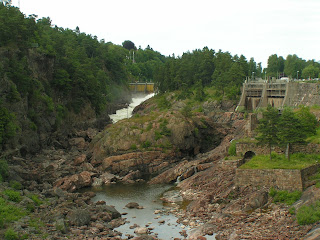
Trollhättan is another of those places people like me are just going to like. Historically it was as far up the Göta river as boats could come into the interior of Sweden before hitting some inconveniently placed 30m high waterfalls. All that is in the past, now, with the falls bypassed by locks and canals. Each lock is hacked or blasted out of solid rock which means, once it's hacked, there's not much more you can do with it when it's served its time, apart from abandon it and start a new one. So, the old locks are still there in successive generations of size and depth, from the original which could barely have handled a narrowboat (and never handled anything; it was just too ambitious in height to for the gates to have withstood the pressure) to the present day one which can take small ships.


And what of the falls themselves, you cry? Tell us, for we must know! Well, they're still there. Again, there's not a lot you can do with a redundant set of falls that no longer have water running over them. They're sealed off by sluice gates and look quite picturesque when they're dry ...

... but even more picturesque when the sluices open for 10 minutes at 3pm every day to relieve pressure and 300,000 litres a second comes barrelling down the gorge.


A bit like watching those tsunami videos, it all seems to be happening so slowly. The water seems to take forever to reach you and yet suddenly it's there and you're really quite glad that you're not, and are in fact on the 30m high bridge overlooking the scene.
If Ozymandias had dug into rock rather than built statues of himself out of it, there would be a lot more evidence of his works to despair at.


And what of the falls themselves, you cry? Tell us, for we must know! Well, they're still there. Again, there's not a lot you can do with a redundant set of falls that no longer have water running over them. They're sealed off by sluice gates and look quite picturesque when they're dry ...

... but even more picturesque when the sluices open for 10 minutes at 3pm every day to relieve pressure and 300,000 litres a second comes barrelling down the gorge.


A bit like watching those tsunami videos, it all seems to be happening so slowly. The water seems to take forever to reach you and yet suddenly it's there and you're really quite glad that you're not, and are in fact on the 30m high bridge overlooking the scene.
If Ozymandias had dug into rock rather than built statues of himself out of it, there would be a lot more evidence of his works to despair at.
Tuesday, July 10, 2012
Var optimist!
I have a new hero and I bet you've never heard of him, unless you're Swedish. Gustaf Dahlén: self-taught engineering genius and polymath, inventor of cookers and lighthouse equipment among many other things, one of the founders of AGA, and social visionary. Raised on a farm with no education beyond the basic that the village school could provide, he went on to create an engineering company with fingers in a thousand pies and which pioneered modern concepts like profit sharing and employee engagement.
The Dahlén Museum in Stenstorp is retro-engineering heaven, and where else would you find a heart and lung machine with an AGA logo?

And wood and formica, and buttons to press and dials to turn. So many ...


It's purely coincidental that it looks like a line of code ...
The Dahlén Museum in Stenstorp is retro-engineering heaven, and where else would you find a heart and lung machine with an AGA logo?

And wood and formica, and buttons to press and dials to turn. So many ...


Not to mention an actual AGA car (briefly manufactured in the 1930s) and, the thing that really made him famous, lighthouse equipment: pre-electronic, pre-electrical and only requiring precision engineering and sound mechanical principles to work. Like his sun valve, a device powered only by thermal expansion to make sure lighthouse lights only came on at night, and which could also drive the rotation of the mechanism. The one installed in Stockholm harbour worked flawlessly until the 1980s without any servicing.
Sadly neither of those photograph particularly well in the museum.
Two things in particular that I like about him. One was that, as a teenager, he anticipated Wallace & Gromit by 100 years and invented a device that would turn on the light and the heating and make the coffee before he got out of bed in the morning. He was going to go one step further and make a device that would tilt the bed to get him out of it, but was talked out of it by his younger brother, who had to share the bed with him.
The other is that even though he was blinded for life at the age of 43, in an explosion while testing the pressure-holding capabilities of different types of cylinder, he was an incurable optimist. His motto was "Var Optimist" ("Be an optimist") and he had hundreds of badges made saying just that, which he would whip out and pin onto any prophet of woe that he might encounter.

Sunday, June 24, 2012
101 miles in Dalmatia
I had been looking forward to this for so long. The more I got sick of our pathetic excuse of a wet and miserable English summer, the more I was looking at the weather profile for Split, Croatia. Sunny, 32 degrees. Sunny, 34 degrees. Sunny - oh, my - 37 degrees. Do such temperatures exist?
Though there does come a time after about the 35th degree when you start to think, okay, it could be turned down a little. Unusually for me, I was actively not looking forward to going to bed at the end of each day, no matter how tired I felt, because I knew how hot and close the cabin would be. If there had been room on deck to sleep then I would have; but on a 36-foot yacht, that's not going to happen.

The plan: five of us (self, Beloved, Bonusbarn, both parents) hire a yacht via Seafarers that would be part of a flotilla sailing from point to point along the Dalmatian coast. Each day would have a destination for the evening, and in between we would get some sailing.
I did a lot of sailing as a teenager but had done none at all since my late twenties - 1993, to be precise. It comes back to you. This was a spanking modern boat in comparison to the primitive ketches on which I learnt my art, but sometimes I found myself hankering for the old days. An electric windlass to lower and raise the anchor is nice, certainly nicer than doing it all by hand ... until it keeps overloading and someone needs to duck below to reset the trip switch. Roller reefing - where the sails wrap around the forestay, or the inside of the mast, rather than requiring actual hauling - certainly grows on you, until it goes wrong, i.e. the rolling no longer rolls. I cut my teeth on a pitching foredeck where, if you wanted sails of a different size, you damn well went forward, took one down, unclipped it from the forestay, clipped another on and hauled it up instead. Sometimes tiring, but at least it went up and down like it was supposed to.
But I quibble. We had a plan and a very nice plan it was. Sometimes the daily destinations were just far apart enough that you had to spend all day just getting there, very often motoring, rather than any of that fancy sailing stuff. But they were very nice destinations.
Primošten is a former fishing village, now transformed into very picturesque tourist trap, perched on a peninsula overlooked by a church at the very top. It is also renowned for its ice cream. All the stops we passed through had good ice cream but Primošten took it to an added degree of artistry.

It was during our stay here that Croatia played Spain and we found that all the World Cup fans had hung onto their Zulu vulvas or whatever they're called. But the noise didn't last much past midnight.
From Primostan to Šibenik, which ought to grace the cover and be the setting of many a fantasy novel. It's approached down a narrow stretch of river between sunbaked cliffs (I say narrow; it could still take a medium sized cargo ship but the cliffs make it seem narrower). You pass Tito's submarine pens ...

... and then Šibenik comes into view. The river broadens into a wide harbour and the town is perched on the far bank, dominated by two castles and a cathedral and looking magical.

But we didn't have time to stop there, because we had to turn left and motor up the river to Skradin, which is as far as the river is navigable. This was another journey that should be part of a fantasy novel because the cliffs get even more towering and you start imagining silhouettes of injuns or Sandpeople along the top. Skradin is the gateway to the Krka National Park, an area defined by astonishing waterfalls, which are the reason why the river stops being navigable at this point.

This was the closest I have been to a real-life Rivendell. The waterfalls play games with you. There are the main falls, a multiple flight reaching back about a quarter of a mile or so, but also smaller ones - torrents of pure white water bursting out of the undergrowth around you as you walk. Wooden boardwalks and stone channels have been set up so that tourists can stroll among them, and the stone channels have been done in such a way that if they aren't the product of a long dead civilisation then they damn well should be.
It was in Skradin that we had Peka, a national dish of beef or lamb or fish baked together with potatoes and vegetables in a dish surrounded by charcoal. Only we didn't have beef or lamb or fish, we had octopus, which was a lot nicer than it ought to have been. I thought I was safe because each dish needed at least four takers to be ordered, and I couldn't believe there would be four takers in the entire flotilla. There turned out to be four takers in our boat, damn it, so I reluctantly let myself be the fifth. And it was nice, as I say, though when the cover was removed and we gazed down in awe at all those sucker-speckled tentacles, I still had to fight the conviction that it was about to leap up at my face and plant some kind of embryo inside me.
But Split, the start and the end point of our voyage, is the place I have the greatest affection for. It goes back to Roman times and beyond, but the waterfront is modern and clean and welcoming.


At the same time its ancient heart is there for all to see. The medieval town grew out of Diocletian's retirement palace, like a tree bursting out of an old pot. (Diocletian retired to the land of his birth to live a life of rustic simplicity, planting cabbages; but being an ex-Roman Emperor, his idea of rustic simplicity still involved living in a palace.) We ate dinner on our final night in an outdoor restaurant that was literally in the shadow of Diocletian's mausoleum, now the cathedral.


Then we want a-wandering and found a town full of life and buzz, and varied entertainments.

Then we accidentally found ourselves wandering through the basement of the palace itself. There's a thriving market of stalls down there.

Accidentally! With no warning! Going back the next day, before our flight, we found places you actually did have to pay to get into - the equivalent of less than a fiver will get you access to a labyrinth of high vaulted stone rooms in a state of repair that would make the people of Bath weep with envy.

It was also considerably cooler, which made our final hours in the country a lot more comfortable than they could have been.
To Croatia itself, I can only wish the very best, because it deserves it. An old people with a young heart, only officially independent since 1995; energetic, friendly, full of ambition and intelligence. I would love to see more of it ... but if we go at this time of year again, or later, I'm staying near the sea.

Though there does come a time after about the 35th degree when you start to think, okay, it could be turned down a little. Unusually for me, I was actively not looking forward to going to bed at the end of each day, no matter how tired I felt, because I knew how hot and close the cabin would be. If there had been room on deck to sleep then I would have; but on a 36-foot yacht, that's not going to happen.

The plan: five of us (self, Beloved, Bonusbarn, both parents) hire a yacht via Seafarers that would be part of a flotilla sailing from point to point along the Dalmatian coast. Each day would have a destination for the evening, and in between we would get some sailing.
I did a lot of sailing as a teenager but had done none at all since my late twenties - 1993, to be precise. It comes back to you. This was a spanking modern boat in comparison to the primitive ketches on which I learnt my art, but sometimes I found myself hankering for the old days. An electric windlass to lower and raise the anchor is nice, certainly nicer than doing it all by hand ... until it keeps overloading and someone needs to duck below to reset the trip switch. Roller reefing - where the sails wrap around the forestay, or the inside of the mast, rather than requiring actual hauling - certainly grows on you, until it goes wrong, i.e. the rolling no longer rolls. I cut my teeth on a pitching foredeck where, if you wanted sails of a different size, you damn well went forward, took one down, unclipped it from the forestay, clipped another on and hauled it up instead. Sometimes tiring, but at least it went up and down like it was supposed to.
But I quibble. We had a plan and a very nice plan it was. Sometimes the daily destinations were just far apart enough that you had to spend all day just getting there, very often motoring, rather than any of that fancy sailing stuff. But they were very nice destinations.
Primošten is a former fishing village, now transformed into very picturesque tourist trap, perched on a peninsula overlooked by a church at the very top. It is also renowned for its ice cream. All the stops we passed through had good ice cream but Primošten took it to an added degree of artistry.

It was during our stay here that Croatia played Spain and we found that all the World Cup fans had hung onto their Zulu vulvas or whatever they're called. But the noise didn't last much past midnight.
From Primostan to Šibenik, which ought to grace the cover and be the setting of many a fantasy novel. It's approached down a narrow stretch of river between sunbaked cliffs (I say narrow; it could still take a medium sized cargo ship but the cliffs make it seem narrower). You pass Tito's submarine pens ...

... and then Šibenik comes into view. The river broadens into a wide harbour and the town is perched on the far bank, dominated by two castles and a cathedral and looking magical.

But we didn't have time to stop there, because we had to turn left and motor up the river to Skradin, which is as far as the river is navigable. This was another journey that should be part of a fantasy novel because the cliffs get even more towering and you start imagining silhouettes of injuns or Sandpeople along the top. Skradin is the gateway to the Krka National Park, an area defined by astonishing waterfalls, which are the reason why the river stops being navigable at this point.

This was the closest I have been to a real-life Rivendell. The waterfalls play games with you. There are the main falls, a multiple flight reaching back about a quarter of a mile or so, but also smaller ones - torrents of pure white water bursting out of the undergrowth around you as you walk. Wooden boardwalks and stone channels have been set up so that tourists can stroll among them, and the stone channels have been done in such a way that if they aren't the product of a long dead civilisation then they damn well should be.
It was in Skradin that we had Peka, a national dish of beef or lamb or fish baked together with potatoes and vegetables in a dish surrounded by charcoal. Only we didn't have beef or lamb or fish, we had octopus, which was a lot nicer than it ought to have been. I thought I was safe because each dish needed at least four takers to be ordered, and I couldn't believe there would be four takers in the entire flotilla. There turned out to be four takers in our boat, damn it, so I reluctantly let myself be the fifth. And it was nice, as I say, though when the cover was removed and we gazed down in awe at all those sucker-speckled tentacles, I still had to fight the conviction that it was about to leap up at my face and plant some kind of embryo inside me.
But Split, the start and the end point of our voyage, is the place I have the greatest affection for. It goes back to Roman times and beyond, but the waterfront is modern and clean and welcoming.


At the same time its ancient heart is there for all to see. The medieval town grew out of Diocletian's retirement palace, like a tree bursting out of an old pot. (Diocletian retired to the land of his birth to live a life of rustic simplicity, planting cabbages; but being an ex-Roman Emperor, his idea of rustic simplicity still involved living in a palace.) We ate dinner on our final night in an outdoor restaurant that was literally in the shadow of Diocletian's mausoleum, now the cathedral.


Then we want a-wandering and found a town full of life and buzz, and varied entertainments.

Then we accidentally found ourselves wandering through the basement of the palace itself. There's a thriving market of stalls down there.

Accidentally! With no warning! Going back the next day, before our flight, we found places you actually did have to pay to get into - the equivalent of less than a fiver will get you access to a labyrinth of high vaulted stone rooms in a state of repair that would make the people of Bath weep with envy.

It was also considerably cooler, which made our final hours in the country a lot more comfortable than they could have been.
To Croatia itself, I can only wish the very best, because it deserves it. An old people with a young heart, only officially independent since 1995; energetic, friendly, full of ambition and intelligence. I would love to see more of it ... but if we go at this time of year again, or later, I'm staying near the sea.

Thursday, June 14, 2012
Prometheus
So, Prometheus. Well worth the evening out. Well acted and beautifully produced. Noomi Rapace has a great future: a Swedish Sigourney Weaver for the present day, who one day will get an international role that doesn't require wearing skin-tight suits. The ship Prometheus itself is a thing of beauty, to be added to the canon of all-time great starships. It doesn’t do much more than provide a vehicle and a habitable environment for the humans to have their adventure, but it still dominates its screen time like an extra character. The effects are astonishingly good: by which I mean CGI, where it happens, is made to look like superlatively good model work. I can think of no higher praise.
I was also very pleased to see the movie in 2D. 3D would have been entirely superfluous. Some shots would have looked impressive but added nothing to the story and would certainly not be worth the extra expense.
Yes, there were things wrong with it but not enough to negate the experience of having gone. Even so, the criticism will take a disproportionate amount of this blog up. Don’t take it personally.
Movies dealing with matters of faith really should get a consultant in who actually has some, rather than someone who has just been told about it. Credit to the writers, they at least are aware that people with faith don’t just chuck the faith in when faced with Science and Reason and apparent contradictions. What they don’t quite get is why this is so. Thus the plot keeps stumbling over Z-level theological conundra of mind-numbing inconsequentiality, which is as irritating as a driver inexplicably dropping into third gear from time to time when he could just cruise in fourth all the way.
Many reviews I’ve seen devote time to the plot holes. I actually think these were script holes, which I’ll come to. Mostly these alleged plot holes revolve around the apparent illogic of the Engineers’ actions. This didn’t bother me for a number of reasons.
1. All we have to judge their actions against is Noomi’s drawn-from-thin-air assertion that they are our progenitors and have invited us. She might be wrong. In fact, I think she was. The engineers that we saw could sculpt a monument the size of Australia, giving a star map that could only be read from space, or at least leave a signature in a glacier somewhere. Rock scribblings of a consistent star map that are separated by thousands of miles and centuries are impressive, sure, but they do not constitute an invitation. (Oh yes, and deduct a further 10 points from the script writers for equating "galactic configuration", whatever one of those is, with what we lesser beings prefer to call "a solar system".)
2. Okay, assume it was invitation. Whatever the Engineers set up was done thousands of years ago. LV-233 might have been a paradise planet back then. Meanwhile factions rise and fall, policies change. Demanding consistency on that timescale would require a monolithic Star Trek-type civilisation where everyone thinks and acts in exactly the same way, for millennia. This is known technically as “bad science fiction (example of)”.
3. All we are seeing is a tiny slice of the Engineers' world. You couldn’t extrapolate 21st century global politics by excavating the Great Pyramid.
4. Maybe the invitation was misunderstood? I’m put in mind of a short story I read years ago, “Dark benediction” by Walter M. Miller, which dates from 1951 and must be one of the earliest zombie apocalypse tales. In this case the apocalypse is wrought by a meteorite that was cut open by scientists, revealing a kind of parasitic goo which starts to infect people. What they didn’t notice was that the meteorite contained many layers. It was in fact intended as a gift. The donors assumed Earth scientists would think as they did and cut the thing open layer by layer, releasing ever increasing levels of technology, each one helping them to understand the next, so that by the time they reached the core they would know exactly what they were handling.
Anyway. Noomi herself excuses any illogicality in the story by noticing it and resolving to resolve it. So there.
The more geeky reviews wonder why, as this is a prequel to Alien, the crew of Nostromo didn’t pick up traces of the earlier expedition or the Engineers’ artefacts? My answer is twofold. Geeky: Nostromo landed in the middle of a storm with visibility reduced to tens of metres, and all sensor data was being handled by Ash the Evil Android and the ship’s computer, which had been programmed to consider the crew expendable. Less geekily: Alien was made over 30 years ago and Ridley Scott had no idea he would one day be revisiting the story.
So that’s the plot holes. Now the script holes …
The actors were good, and could all convince me as being specialists in one area who were out of their depths in another: again, like the Nostromo crew. They get a heck of a lot more sympathy than the frankly incompetent marines of Aliens who deserved everything they got. Most of the time the characters act as they do because that is what normal people would do and they have no idea they’re in the prequel to Alien.
But then their characters are made to do silly things. The biologist doesn’t notice alien life forms literally manifesting beneath his feet. They establish that air is breathable, but don’t check what else might be in it before breathing it. Sans helmets, they open a door which might have unbreathable air behind it. Even the archaeologist acts surprised that their entry seems to have disturbed the equilibrium of somewhere that has lain undisturbed for millennia.
Oddest of all was when time seemed to stand still, or flow backwards, or something, onboard Prometheus. Violence occurs between characters, the ship’s procedures for preventing alien infiltration are blown to hell, and a woman is found wandering the corridors in her undies and covered in blood. No one even gives her a “‘Zup?” - they just carry on with the plot, including the people she has just beaten up who might at least cast her a dark glance.
Meanwhile, for no reason other than an additional 5 seconds of tension, an expensive item of medical equipment that has previously been firmly established to be the sole property and for the sole use of a female character is revealed to be configured for male bodies only.
Other things.
Why get a relatively young actor to play an older man when it entails swaddling him in layers of Star Trek latex? Why not save on at least a couple of layers by getting an older actor?
Why are axes standard issue in lifepods (apparently)?
And Ridley Scott’s sense of plausible timescales still irritates. It irritated me in Blade Runner, when I was expected to believe that a mere 40 years hence - 7 years hence, from where I’m now sitting - flying cars would be the norm and a character could plausibly bang on about attack ships on fire off the shoulder of Orion. Now I’m expected to believe we’ll have viable interstellar travel, albeit requiring two years in hibernation, by the 2090s.
Quibbles, quibbles. It's fun. Enjoy it.
And now some links.
Prometheus: an archaeological perspective (sort of) skewers it far more enjoyably than I can. Prometheus Unbound: What The Movie Was Actually About offers an alarmingly well thought out alternative reason for why everything went wrong, which is almost certainly not what Ridley Scott had in mind but makes perfect plot sense.
I was also very pleased to see the movie in 2D. 3D would have been entirely superfluous. Some shots would have looked impressive but added nothing to the story and would certainly not be worth the extra expense.
Yes, there were things wrong with it but not enough to negate the experience of having gone. Even so, the criticism will take a disproportionate amount of this blog up. Don’t take it personally.
Movies dealing with matters of faith really should get a consultant in who actually has some, rather than someone who has just been told about it. Credit to the writers, they at least are aware that people with faith don’t just chuck the faith in when faced with Science and Reason and apparent contradictions. What they don’t quite get is why this is so. Thus the plot keeps stumbling over Z-level theological conundra of mind-numbing inconsequentiality, which is as irritating as a driver inexplicably dropping into third gear from time to time when he could just cruise in fourth all the way.
Many reviews I’ve seen devote time to the plot holes. I actually think these were script holes, which I’ll come to. Mostly these alleged plot holes revolve around the apparent illogic of the Engineers’ actions. This didn’t bother me for a number of reasons.
1. All we have to judge their actions against is Noomi’s drawn-from-thin-air assertion that they are our progenitors and have invited us. She might be wrong. In fact, I think she was. The engineers that we saw could sculpt a monument the size of Australia, giving a star map that could only be read from space, or at least leave a signature in a glacier somewhere. Rock scribblings of a consistent star map that are separated by thousands of miles and centuries are impressive, sure, but they do not constitute an invitation. (Oh yes, and deduct a further 10 points from the script writers for equating "galactic configuration", whatever one of those is, with what we lesser beings prefer to call "a solar system".)
2. Okay, assume it was invitation. Whatever the Engineers set up was done thousands of years ago. LV-233 might have been a paradise planet back then. Meanwhile factions rise and fall, policies change. Demanding consistency on that timescale would require a monolithic Star Trek-type civilisation where everyone thinks and acts in exactly the same way, for millennia. This is known technically as “bad science fiction (example of)”.
3. All we are seeing is a tiny slice of the Engineers' world. You couldn’t extrapolate 21st century global politics by excavating the Great Pyramid.
4. Maybe the invitation was misunderstood? I’m put in mind of a short story I read years ago, “Dark benediction” by Walter M. Miller, which dates from 1951 and must be one of the earliest zombie apocalypse tales. In this case the apocalypse is wrought by a meteorite that was cut open by scientists, revealing a kind of parasitic goo which starts to infect people. What they didn’t notice was that the meteorite contained many layers. It was in fact intended as a gift. The donors assumed Earth scientists would think as they did and cut the thing open layer by layer, releasing ever increasing levels of technology, each one helping them to understand the next, so that by the time they reached the core they would know exactly what they were handling.
Anyway. Noomi herself excuses any illogicality in the story by noticing it and resolving to resolve it. So there.
The more geeky reviews wonder why, as this is a prequel to Alien, the crew of Nostromo didn’t pick up traces of the earlier expedition or the Engineers’ artefacts? My answer is twofold. Geeky: Nostromo landed in the middle of a storm with visibility reduced to tens of metres, and all sensor data was being handled by Ash the Evil Android and the ship’s computer, which had been programmed to consider the crew expendable. Less geekily: Alien was made over 30 years ago and Ridley Scott had no idea he would one day be revisiting the story.
So that’s the plot holes. Now the script holes …
The actors were good, and could all convince me as being specialists in one area who were out of their depths in another: again, like the Nostromo crew. They get a heck of a lot more sympathy than the frankly incompetent marines of Aliens who deserved everything they got. Most of the time the characters act as they do because that is what normal people would do and they have no idea they’re in the prequel to Alien.
But then their characters are made to do silly things. The biologist doesn’t notice alien life forms literally manifesting beneath his feet. They establish that air is breathable, but don’t check what else might be in it before breathing it. Sans helmets, they open a door which might have unbreathable air behind it. Even the archaeologist acts surprised that their entry seems to have disturbed the equilibrium of somewhere that has lain undisturbed for millennia.
Oddest of all was when time seemed to stand still, or flow backwards, or something, onboard Prometheus. Violence occurs between characters, the ship’s procedures for preventing alien infiltration are blown to hell, and a woman is found wandering the corridors in her undies and covered in blood. No one even gives her a “‘Zup?” - they just carry on with the plot, including the people she has just beaten up who might at least cast her a dark glance.
Meanwhile, for no reason other than an additional 5 seconds of tension, an expensive item of medical equipment that has previously been firmly established to be the sole property and for the sole use of a female character is revealed to be configured for male bodies only.
Other things.
Why get a relatively young actor to play an older man when it entails swaddling him in layers of Star Trek latex? Why not save on at least a couple of layers by getting an older actor?
Why are axes standard issue in lifepods (apparently)?
And Ridley Scott’s sense of plausible timescales still irritates. It irritated me in Blade Runner, when I was expected to believe that a mere 40 years hence - 7 years hence, from where I’m now sitting - flying cars would be the norm and a character could plausibly bang on about attack ships on fire off the shoulder of Orion. Now I’m expected to believe we’ll have viable interstellar travel, albeit requiring two years in hibernation, by the 2090s.
Quibbles, quibbles. It's fun. Enjoy it.
And now some links.
Prometheus: an archaeological perspective (sort of) skewers it far more enjoyably than I can. Prometheus Unbound: What The Movie Was Actually About offers an alarmingly well thought out alternative reason for why everything went wrong, which is almost certainly not what Ridley Scott had in mind but makes perfect plot sense.
Monday, June 04, 2012
Res publica
I read several articles over the weekend in various outlets in which former trendy lefty reporter columnist types admitted how their youthful republicanism was gradually turning into something suspiciously pro-monarchy, and all because of the current incumbent of the British throne. I will admit possibly to being one of them.
Tonight, Madness will perform ‘Our House’ on top of Buckingham Palace, all very post-Blair, post-Cool Britannia and democratic, and I’m delighted. But it still can’t beat the sight of a rain-drenched chorus from the London Philharmonic singing ‘Land of Hope and Glory’ and ‘Rule Britannia’ and the national anthem in the middle of the Thames, while an old lady of 86 stands, as she has stood for four hours, in the pouring rain, because she knows she owes it to the many who have come to pay their respects to her.
I am equally pleased that a short distance away, near City Hall, the ‘biggest republican protest in living memory’ was under way and getting all the TV time it deserved under the circumstances, which is to say, none. Even John Barrowman on the belfry barge, putting the camp into campanology, got more time than they did.
From Republic’s own web site: ‘Earlier this month Republic published a new pamphlet – 60 Inglorious Years – which argues that the Queen’s reign has been characterised by “personal enrichment, feeble leadership and an obstinate refusal to allow real scrutiny of her role”.’
Oh Get Over Yourself You Big Tart.
Don’t get me wrong. There is absolutely no doubt that in principle, in cold, rational theory, on paper, a republic is the most just and appropriate form of government for our time. In my own trendy student days (I had a few) I remember the republican cause frequently being put down by “two words: President Thatcher”, which was a fatuous argument that convinced absolutely no one who actually knew anything about politics. A republic does not have to have the same presidential system as the United States. In the event of this country ever becoming a republic at all, it will almost certainly be a parliamentary republic, with two Houses of Parliament and a Prime Minister recognisably similar to what we already have (though both Houses will be elected; possibly a subject of another post) and the President simply taking on the Queen’s current figurehead executive role. President Thatcher would be as important as President Whoever who is currently in charge of Germany.
(Anyway, Thatcher would never consent to such a role. She was too much of a snob, the figurehead of the arriviste Margo Leadbetter class who need, indeed, require a monarchy above them to emphasise their own branch of the tree.)
But the republic, if/when it comes, should be the grandest achievement of our history, the final emergence from the dark ages into the age of the post-Enlightenment. It should not be characterised by the petulant whine of a five year old complaining that it’s not fair.
And there is one other thing a republic needs. Giants. Abraham Lincoln, Franklin D. Roosevelt, Charles de Gaulle, Mary Robinson, even Jed Bartlet – in fact, it needs a steady succession of them as presidential terms expire and new holders take up the position. What could be a grander, prouder title to bear than President of the Republic? A republic could even get by quite comfortably with the present generation of political pygmies in all the legislative roles, as they currently are, so long as the executive was a step above.
I see no giants.
Short of an actual revolution – never going to happen – I see one way the republic could happen, and it would be a good way, and who knows, it might even give us the right sort of presidential material. The monarchy needs to attack itself from within. Charles waits until his mother has decently passed on, then announces that he will be the last monarch of Great Britain, and that he is now going to set the movement towards a republic in motion. The power of the monarchy is gradually phased out in favour of a president, possibly taking decades to do it, and a thousand years of generally glorious history comes peacefully and inevitably to an end.
It has happened before, and quite recently, in Spain. In that case it was the transition from dictatorship to constitutional monarchy, rather than constitutional monarchy to republic, but the same processes could apply. The king personally supervised the transition and grew immensely in stature as a result.
Maybe it will never happen. In fact, probably not. So this is my challenge to Republic: stop whining and give us the giants. Give us someone else of the same stature as that 86-year-old lady in the rain and then maybe you’ll get your wish.
Tonight, Madness will perform ‘Our House’ on top of Buckingham Palace, all very post-Blair, post-Cool Britannia and democratic, and I’m delighted. But it still can’t beat the sight of a rain-drenched chorus from the London Philharmonic singing ‘Land of Hope and Glory’ and ‘Rule Britannia’ and the national anthem in the middle of the Thames, while an old lady of 86 stands, as she has stood for four hours, in the pouring rain, because she knows she owes it to the many who have come to pay their respects to her.
I am equally pleased that a short distance away, near City Hall, the ‘biggest republican protest in living memory’ was under way and getting all the TV time it deserved under the circumstances, which is to say, none. Even John Barrowman on the belfry barge, putting the camp into campanology, got more time than they did.
From Republic’s own web site: ‘Earlier this month Republic published a new pamphlet – 60 Inglorious Years – which argues that the Queen’s reign has been characterised by “personal enrichment, feeble leadership and an obstinate refusal to allow real scrutiny of her role”.’
Oh Get Over Yourself You Big Tart.
Don’t get me wrong. There is absolutely no doubt that in principle, in cold, rational theory, on paper, a republic is the most just and appropriate form of government for our time. In my own trendy student days (I had a few) I remember the republican cause frequently being put down by “two words: President Thatcher”, which was a fatuous argument that convinced absolutely no one who actually knew anything about politics. A republic does not have to have the same presidential system as the United States. In the event of this country ever becoming a republic at all, it will almost certainly be a parliamentary republic, with two Houses of Parliament and a Prime Minister recognisably similar to what we already have (though both Houses will be elected; possibly a subject of another post) and the President simply taking on the Queen’s current figurehead executive role. President Thatcher would be as important as President Whoever who is currently in charge of Germany.
(Anyway, Thatcher would never consent to such a role. She was too much of a snob, the figurehead of the arriviste Margo Leadbetter class who need, indeed, require a monarchy above them to emphasise their own branch of the tree.)
But the republic, if/when it comes, should be the grandest achievement of our history, the final emergence from the dark ages into the age of the post-Enlightenment. It should not be characterised by the petulant whine of a five year old complaining that it’s not fair.
And there is one other thing a republic needs. Giants. Abraham Lincoln, Franklin D. Roosevelt, Charles de Gaulle, Mary Robinson, even Jed Bartlet – in fact, it needs a steady succession of them as presidential terms expire and new holders take up the position. What could be a grander, prouder title to bear than President of the Republic? A republic could even get by quite comfortably with the present generation of political pygmies in all the legislative roles, as they currently are, so long as the executive was a step above.
I see no giants.
Short of an actual revolution – never going to happen – I see one way the republic could happen, and it would be a good way, and who knows, it might even give us the right sort of presidential material. The monarchy needs to attack itself from within. Charles waits until his mother has decently passed on, then announces that he will be the last monarch of Great Britain, and that he is now going to set the movement towards a republic in motion. The power of the monarchy is gradually phased out in favour of a president, possibly taking decades to do it, and a thousand years of generally glorious history comes peacefully and inevitably to an end.
It has happened before, and quite recently, in Spain. In that case it was the transition from dictatorship to constitutional monarchy, rather than constitutional monarchy to republic, but the same processes could apply. The king personally supervised the transition and grew immensely in stature as a result.
Maybe it will never happen. In fact, probably not. So this is my challenge to Republic: stop whining and give us the giants. Give us someone else of the same stature as that 86-year-old lady in the rain and then maybe you’ll get your wish.
Wednesday, May 30, 2012
Where I’m at
Once upon a time there was a young man with the twin
ambitions, not incompatible, of making it big in publishing and becoming a
successful writer. How did he do?
Well, the publishing happened, for a good few years. It didn’t take him long to discover that the bits he enjoyed most were editorial work and hands-on production. The bits that are actually more necessary, from a business model point of view – acquisitions, marketing, royalties, accounts in general, strategy – tended to leave him cold. His ambition to grease his way up any of those particular poles was therefore limited from the start, which led to a career of middling editorial sort of work – books, journals, more books, more journals, more books and oh, a magazine –culminating in the creation and liquidation of his own company. After that he rather felt he had had his fun in publishing and looked around for something with a compatible skillset requirement. Thus he found himself working in communications for a large computer network, which via a stroke-of-the-pen-change to marketing lasted for seven years – the longest this once aspiring publisher had held down any job. Redundancy struck – for the first time in a nearly quarter of a century career, which face it, isn’t bad – and cast him out into the world as an aspiring freelance technical writer, with the understanding that his former employers would be providing about a quarter of his work. No one told that to the marketing drone who replaced him and he was chronically underused, so more by chance than anything else he found himself employed fulltime once more as technical author for a firm that manufactures scientific instruments. His job title is now Communications Executive and to his huge surprise he has ended up in charge of advertisements, amongst other stuff, despite never having bought anything based on an advertisement in his life.
No, it isn’t where he saw himself 25 years ago. But it pays the bills and it leaves time for the other.
Stop sniggering, I do of course mean the writing. What happened there?
Well, it all went swimmingly at first. The writing was very specifically science fiction – okay, and fantasy if pushed, but sf most of all. That was 90% of his reading so it was going to be his writing too. Stories were sprayed at Interzone and other outlets - but mostly Interzone - until a few stuck. An agent was acquired, novels were written and even sold. Four in total. And then?
Well, that company that I, I mean he … I … he … oh, okay, I (you’d guessed, hadn’t you?) founded. It published science fiction. What else was this life-long sf fan going to publish? And it broke the subject. I’ve never been able to work out why. Maybe I looked too closely at what goes on behind the scenes – I saw the wooden supports that hold up the sets and suddenly could no longer suspend the disbelief. I can still read it but the drive to write it had just gone.
There again it’s possible I had just told all the stories that were bubbling inside me. I wrote a few more pieces, using up the last of the ideas bubbling away in the background, and they continue to bubble on slushpiles on either side of the Atlantic. If a publisher shows interest then I have no doubt my own interest will rekindle. But life is too short for writing on spec, and unless they do get taken up then there won’t be any more like them written for the foreseeable.
And I was introduced to Other Stuff. For a while I became Sebastian Rook, writing the first three of the Vampire Plagues series – Mayan vampires in Victorian London, for readers aged <=12. That was fun, and I could use my genre experience (though I say it myself) to deliver that little extra to the plots. The plot for book 1 came ready made; I made some suggestions that were retrofitted into the series background; I was consulted heavily on the plot for book 2; and for book 3 we all sat down in a room together and hacked the plot out from scratch.
That led – same editor, different publisher – into ghostwriting for a Real Life TV Celebrity, not genre at all. At least, not my usual genre. But genre of a sort, and nicely paying too. Rather like a series of H-bomb tests causing something ancient and terrible beneath the Pacific to stir, this caught the attention of my agent, who had not had a lot to do with my career in the intervening years but whose attention I badly needed to catch.
At his suggestion we are now working on a series of historical adventures, and fingers are crossed as to its success. I have come to the conclusion that every historical writer should be an sf writer first. No one knows they are living in the past. As a rule, everyone lives in the most present and up to date world they have ever known, even if it has standards and mores that are utterly alien to cultures that actually come later. For them this is normality and it must be presented as such, with all the important differences signalled to the reader via some means other than an “As you know, Bob” speech every couple of pages. A 32-gun frigate may seem quaint to us but it’s as exciting as a starship to a young man from the late eighteenth century.
And so that is where I am. By a series of utterly logical steps I am a publisher and science fiction writer who is not currently working in publishing or writing science fiction, and has a lurking suspicion that this is How It Is Meant to Be. At least for now. And really quite happy about it.
Keep watching.
Well, the publishing happened, for a good few years. It didn’t take him long to discover that the bits he enjoyed most were editorial work and hands-on production. The bits that are actually more necessary, from a business model point of view – acquisitions, marketing, royalties, accounts in general, strategy – tended to leave him cold. His ambition to grease his way up any of those particular poles was therefore limited from the start, which led to a career of middling editorial sort of work – books, journals, more books, more journals, more books and oh, a magazine –culminating in the creation and liquidation of his own company. After that he rather felt he had had his fun in publishing and looked around for something with a compatible skillset requirement. Thus he found himself working in communications for a large computer network, which via a stroke-of-the-pen-change to marketing lasted for seven years – the longest this once aspiring publisher had held down any job. Redundancy struck – for the first time in a nearly quarter of a century career, which face it, isn’t bad – and cast him out into the world as an aspiring freelance technical writer, with the understanding that his former employers would be providing about a quarter of his work. No one told that to the marketing drone who replaced him and he was chronically underused, so more by chance than anything else he found himself employed fulltime once more as technical author for a firm that manufactures scientific instruments. His job title is now Communications Executive and to his huge surprise he has ended up in charge of advertisements, amongst other stuff, despite never having bought anything based on an advertisement in his life.
No, it isn’t where he saw himself 25 years ago. But it pays the bills and it leaves time for the other.
Stop sniggering, I do of course mean the writing. What happened there?
Well, it all went swimmingly at first. The writing was very specifically science fiction – okay, and fantasy if pushed, but sf most of all. That was 90% of his reading so it was going to be his writing too. Stories were sprayed at Interzone and other outlets - but mostly Interzone - until a few stuck. An agent was acquired, novels were written and even sold. Four in total. And then?
Well, that company that I, I mean he … I … he … oh, okay, I (you’d guessed, hadn’t you?) founded. It published science fiction. What else was this life-long sf fan going to publish? And it broke the subject. I’ve never been able to work out why. Maybe I looked too closely at what goes on behind the scenes – I saw the wooden supports that hold up the sets and suddenly could no longer suspend the disbelief. I can still read it but the drive to write it had just gone.
There again it’s possible I had just told all the stories that were bubbling inside me. I wrote a few more pieces, using up the last of the ideas bubbling away in the background, and they continue to bubble on slushpiles on either side of the Atlantic. If a publisher shows interest then I have no doubt my own interest will rekindle. But life is too short for writing on spec, and unless they do get taken up then there won’t be any more like them written for the foreseeable.
And I was introduced to Other Stuff. For a while I became Sebastian Rook, writing the first three of the Vampire Plagues series – Mayan vampires in Victorian London, for readers aged <=12. That was fun, and I could use my genre experience (though I say it myself) to deliver that little extra to the plots. The plot for book 1 came ready made; I made some suggestions that were retrofitted into the series background; I was consulted heavily on the plot for book 2; and for book 3 we all sat down in a room together and hacked the plot out from scratch.
That led – same editor, different publisher – into ghostwriting for a Real Life TV Celebrity, not genre at all. At least, not my usual genre. But genre of a sort, and nicely paying too. Rather like a series of H-bomb tests causing something ancient and terrible beneath the Pacific to stir, this caught the attention of my agent, who had not had a lot to do with my career in the intervening years but whose attention I badly needed to catch.
At his suggestion we are now working on a series of historical adventures, and fingers are crossed as to its success. I have come to the conclusion that every historical writer should be an sf writer first. No one knows they are living in the past. As a rule, everyone lives in the most present and up to date world they have ever known, even if it has standards and mores that are utterly alien to cultures that actually come later. For them this is normality and it must be presented as such, with all the important differences signalled to the reader via some means other than an “As you know, Bob” speech every couple of pages. A 32-gun frigate may seem quaint to us but it’s as exciting as a starship to a young man from the late eighteenth century.
And so that is where I am. By a series of utterly logical steps I am a publisher and science fiction writer who is not currently working in publishing or writing science fiction, and has a lurking suspicion that this is How It Is Meant to Be. At least for now. And really quite happy about it.
Keep watching.
Subscribe to:
Posts (Atom)